
Pest Control Route Scheduling for Recurring Service
Pest control route scheduling for recurring service: keep quarterlies dense, absorb reservices and skips, and stop route drift in a 1 to 8 truck shop.
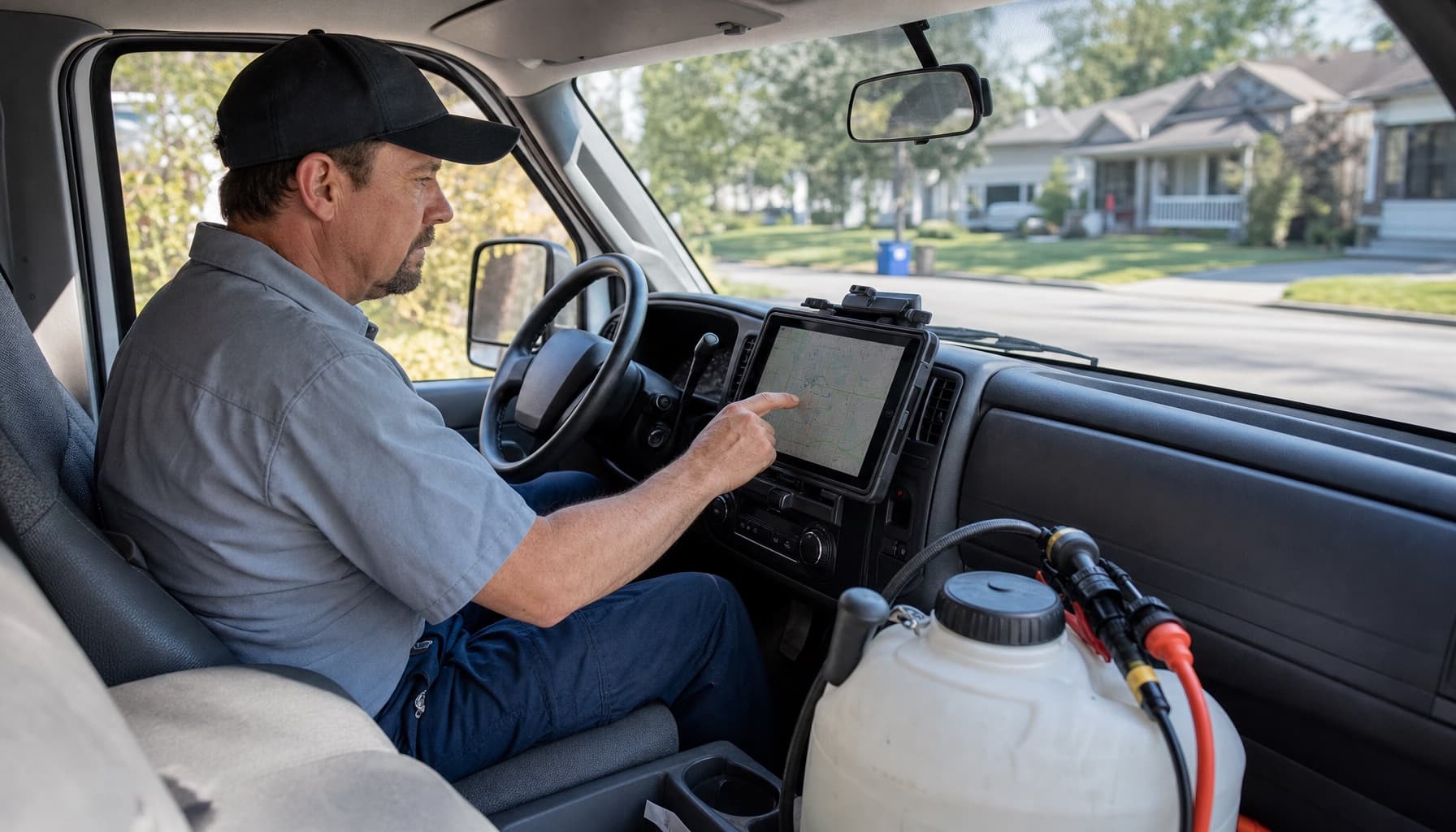
Pest control is the one trade where the schedule is the product. An HVAC shop sells a fixed system and visits when it breaks. You sell the visit itself, over and over: monthlies, bi-monthlies, quarterlies, stretching years past the initial. Which means the thing that decides whether you make money is not your close rate or your chemical cost. It is how many stops each truck runs between eight and five, and how much of that day is windshield time instead of service time.
The operators who study this agree on where the money is. In one industry survey, 55 percent of pest control professionals named route density the single most impactful factor in productivity, first out of ten options. The working benchmark for a healthy operation is drive time under 40 percent of the workday, which on an eight-hour day means no more than about three hours behind the wheel. A general pest route that is built well runs somewhere in the 12 to 18 stop range. A route that has been drifting for two years runs eight, and the tech comes back with the same hours on the clock.
Route drift is the silent killer of recurring service
Here is how a good route dies. Nobody blows it up. It erodes.
You build a tight Tuesday: fourteen quarterlies in two adjacent subdivisions. Then Mrs. Alvarez reschedules because of a graduation, so her stop slides to Thursday, a day your truck is twenty minutes away. A locked gate turns another stop into a skip that has to be worked in next week. A new sale lands eight miles from anything because you did not want to say no. A wasp reservice wedges into Wednesday because the customer is upset and reservices feel urgent.
Each move is reasonable. None of them ever gets moved back. Two years later the Tuesday route is six stops and a lot of driving, and you are hiring a fourth tech to produce what three should.
A quarterly account is not twelve calendar events. It is a standing promise to be in that neighborhood, on that week, for years. The software's job is to defend the neighborhood.
A generic calendar cannot defend it, because a calendar has no opinion. It will happily book Mrs. Alvarez's makeup visit on Thursday across town, and it will treat that as a solved problem. Real recurring route scheduling treats it as an exception: this account is anchored to the Tuesday-north territory, the reschedule is a one-time deviation, and next quarter she snaps back to her anchor day with her neighbors. Anchoring is the whole trick, and it is the feature to grill every vendor about.
What pest control route scheduling has to absorb
The recurring calendar is the easy half. The hard half is the daily debris that recurring service generates, and this is where pest is different from every other trade.
- Reservices. Ants come back between visits and the re-treat is free, so every reservice is pure cost. The only way it does not hurt is if it rides along a route already passing through that area. Software should hold a non-urgent reservice until your truck is next in that territory instead of booking it wherever there is white space. The usual industry target is a reservice rate under 3 percent of stops; over 6 percent and it starts eating a truck.
- Skips. Locked gate, aggressive dog, customer not home for an interior. A skip is not a cancellation; the account still expects its quarter and still gets billed only if you serve it. Skips need to auto-queue for the next pass through the neighborhood, not fall into a notes field.
- Not-homes on interiors. Exterior-only agreements saved a lot of shops for exactly this reason. Where interiors remain, confirmation texts the day before are the difference between a stop and a wasted drive.
- Seasonal surge. Termite swarms, spring ants, fall rodents. Renewal work spikes exactly when new sales spike, and the recurring base cannot quietly slide to make room, because slid quarterlies become cancellations.
We covered the revenue logic of service agreements in the HVAC maintenance agreements playbook, and it transfers almost whole: recurring customers are worth multiples of one-time work. The pest-specific part is that your recurring base has a geography, and protecting the geography is protecting the margin.
The pest control route scheduling software you can actually buy
The honest budget answer in this trade is GorillaDesk. It publishes pricing and runs month to month: Basic at $49 a month with routing capped at 25 stops and no GPS, Pro at $99 with real street routing and team GPS, Growth at $149. The catch is that it is priced per route, so every truck you add raises the bill, and the thinking about drift, reservice ride-alongs, and territory anchoring stays largely with you.
At the other end sit FieldRoutes and PestPac. FieldRoutes, now a ServiceTitan company, is genuinely built for pest and its bulk recurring tools are real. It also does not publish pricing, sells by demo rather than trial, and bills by active customer count, so the software bill climbs with every account you add even though a denser route costs you less to serve. PestPac points the same direction: custom quotes, annual contracts, implementation fees, and reviewers regularly describing setups in the hundreds of dollars a month before modules. Both are sized for the operation with an office manager who lives in the routing screen. If you run four trucks and answer the phone from a crawlspace, that is not you.
The generalist starter apps, Jobber and Housecall Pro, will book recurring visits, but they think in calendars, not territories, and pest is the trade where that distinction is the entire game.
Recurring routes without the enterprise contract
FieldCommerce sits in the gap on purpose. The recurring contracts engine keeps the agreement, the next visit, and the next invoice as one linked thing, so a reschedule moves a visit without unmooring the account from its territory. Reservices and skips queue against the next pass through the neighborhood instead of landing wherever the calendar has a hole. When a customer texts back "not this week," the AI handles the reshuffle and the confirmation message, because in a shop without an office manager the operator is the office manager.
Pull up last quarter and count how many stops your best route ran in April versus what it runs now. If the number went down and nobody decided that, the drift already has a bill attached.
See how it works for this trade at FieldCommerce for pest control, or get started and bring the route that used to be tight.