
Plumbing and Heating Business Software: A Buyer's Guide
Plumbing and heating business software for two-season shops: equipment records, service contracts, no-heat triage, and which vendors actually fit.
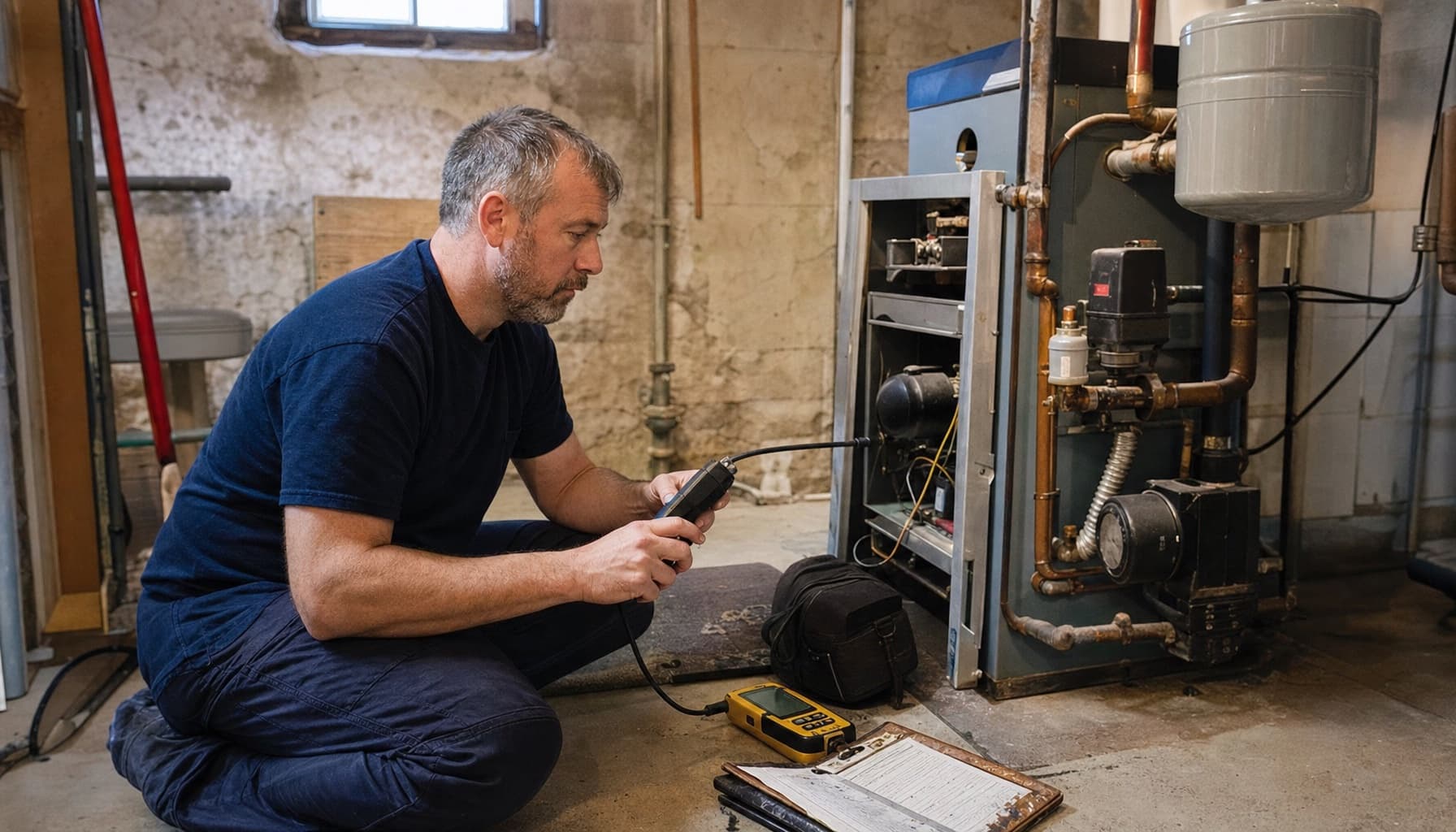
Drive through any town in the Northeast and read the truck doors. A family name, then the same two words: Plumbing & Heating. These shops are often older than the software industry. Second generation, sometimes third. The customer list lives in the owner's head and a drawer of index cards: which house has the oil-fired steam boiler from 1996, who is on the service plan, whose zone valve sticks every October.
Go looking for plumbing and heating business software and you will notice something odd. Every vendor has a plumbing page and an HVAC page, and neither describes you. The plumbing page assumes drain calls and water heaters. The HVAC page assumes condensers and duct runs. A shop whose winter is boilers and whose summer is repipes and bathroom rough-ins falls in the gap between the two brochures.
What plumbing and heating business software has to hold
Start with the thing the index cards actually contain: the equipment record. A no-heat call is a completely different job depending on what is in the basement. Gas-fired hot water with baseboard is one truck and one bag. Oil-fired steam is another. A mod-con that has thrown the same ignition fault twice since January is a third, and the tech who knows that history walks in with the answer half formed.
Generic software treats a customer as a name, an address, and a pile of past invoices. That forces every tech to diagnose the installation before they can diagnose the fault. What a heating shop needs on the customer record is the boiler make and model, the install date, the last cleaning, the aquastat settings somebody fought with in 2023, and the note that says the shutoff for the second-floor zone is behind the water softener.
Then there are the service plans. Most shops price an annual boiler plan somewhere between $100 and $500 depending on what it covers, usually a cleaning and tune-up plus priority when things break. The plans are the backbone of the business, and they create two software jobs at once: remember every renewal date without a human checking a spreadsheet, and flag plan customers the moment they call.
That second part matters more than it sounds. Spend an evening on HeatingHelp's The Wall, the forum where the hydronics old guard argues, and you will find the standing policy at most established shops: when a call comes in, the office checks whether the account is current and whether the caller is on a contract, and contract customers go to the front of the line.
A no-heat call from a plan customer is not the same ticket as a no-heat call from a stranger, and the software should know that before the second ring.
The season runs the schedule, not the calendar
A plumbing and heating shop does not have a steady week. It has a shape. September and October are startup season, when everyone who ignored the boiler all summer wants it cleaned in the same six weeks. Then the first real cold snap arrives and the no-heat calls all land at once, because every marginal boiler in town hits its limit on the same night. Nobody calls when it is 45 degrees out.
Software earns its keep in that shape or it doesn't. The scheduling question is not "is Tuesday open" but "how do I spread 180 contract cleanings across August and September so October is not a wall of them," and then "when fourteen no-heat calls land on a Saturday in January, which ones are plan customers, which house has which boiler, and who on my crew can run an oil burner." A calendar app answers none of that. It shows you Tuesday.
The summer side is quieter but not optional. Water heaters, repipes, fixture swaps, the remodel work that keeps the trucks moving until fall. The shops that smooth the swing use the tune-up visit as a scout: a cracked heat exchanger found in September is a boiler swap booked in October instead of an emergency in January. We covered how to build that flywheel in our maintenance agreements playbook, and it works the same on hydronics as it does on forced air.
Shopping for plumbing and heating business software
Now the vendor grid, with the two-trade lens on.
Jobber and Housecall Pro are the names you will hear first, and both will run a small shop fine. Just read the pricing pages slowly. Jobber's Core plan advertises $21 a month on annual billing against $49 month to month, but the fine print says the annual figure is an introductory rate for the first twelve months, and every additional user is $29 on every tier. Neither product has any real concept of equipment, so the boiler history ends up crammed into job notes where the next tech may or may not scroll far enough.
Service Fusion flips the seat math with unlimited users from $208 a month on annual billing, and it does carry equipment records, which is why HVAC-rooted shops end up there. The trade-off is a product that assumes an office is running dispatch. If your dispatcher is you, in a truck, between calls, that assumption costs you all day.
ServiceTitan handles all of this and will happily manage a 40-truck operation's every breath. At three trucks you would be paying enterprise money and running a tenth of it. The honest sorting question for the whole list is the one we laid out in our two-trade shop guide: does the system know what is installed in the house and who is allowed to touch it, or is it a calendar wearing your trade's name?
FieldCommerce sits in the middle that the combined shop actually occupies. It was built AI-first for 1 to 8 truck operations, which changes what the software does with all that history instead of just storing it. The equipment record lives on the customer, so when the office asks about the Callahans, the AI answers with the boiler, the plan status, and the two ignition faults since January. Contract renewals chase themselves. The invoice drafts itself from what the tech says happened, T&M or flat rate, and the follow-up goes out whether or not anyone remembered. The pricing is published for every plan, so you can compare it against the grids above without sitting through a demo.
The card file got your shop this far because it held what mattered: the house, the iron in the basement, and the promise behind the plan. Pick software by the same standard. See how it fits at FieldCommerce for plumbing, or get started before startup season buries you.