
HVAC Field Service Software: Built for the Repair Economy
HVAC field service software for 1 to 8 truck shops: why the repair boom changes what to buy, and an honest read on ServiceTitan, FieldEdge, and the rest.
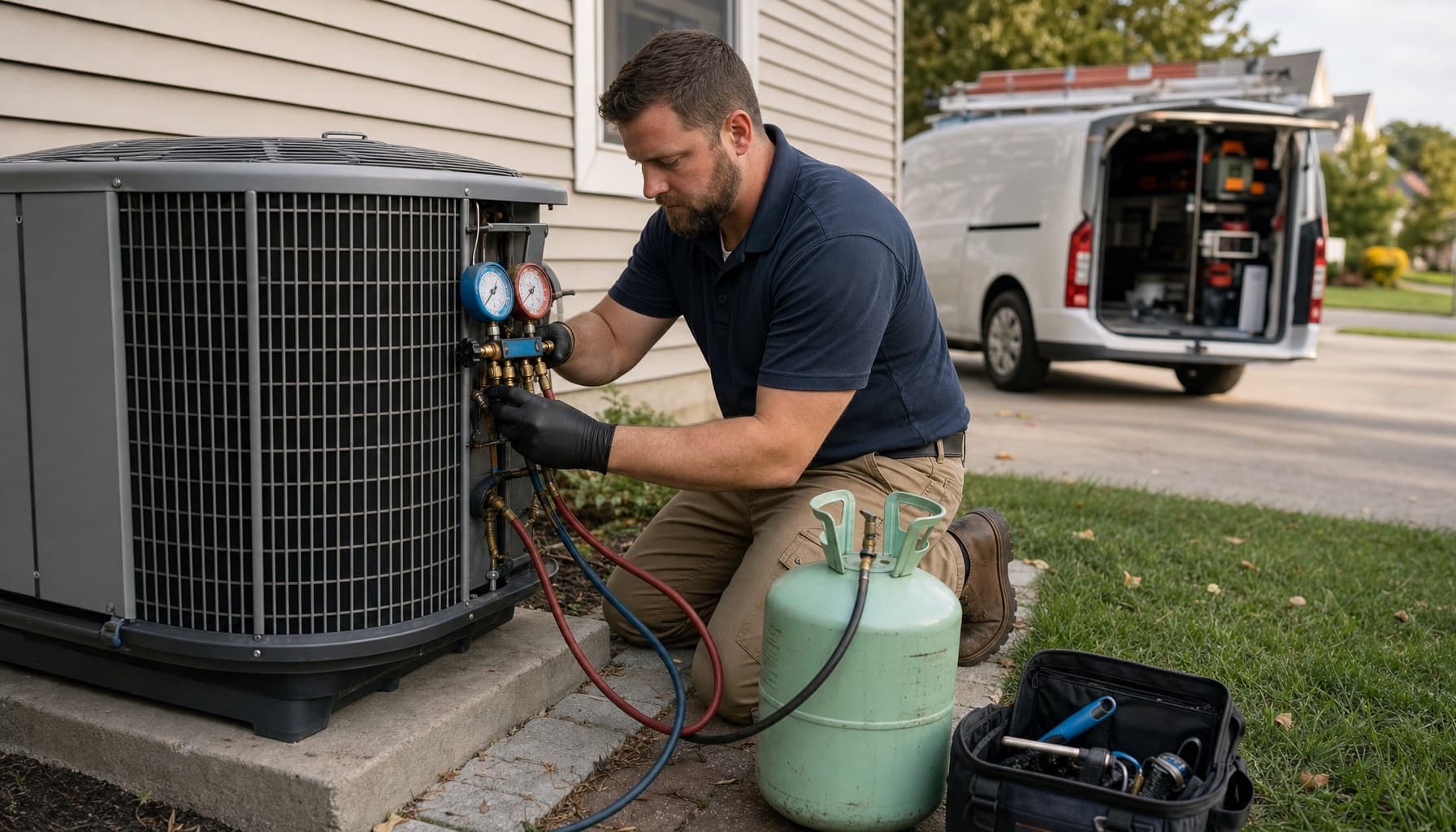
Something shifted in the HVAC business between 2021 and now, and most owners felt it in the call mix before anyone graphed it. The replacement quote got scary. The EPA pushed manufacturers onto A2L refrigerants, the new R-454B equipment came in more expensive, and the refrigerant itself went sideways: about $8 a pound in late 2021, $17 to $20 a pound by 2025, with contractors reporting jug prices jumping $500 in a span of months during the shortage. Homeowners started hearing five-figure numbers for a system swap and doing the math on one more repair instead.
The numbers back up the feeling. Housecall Pro analyzed roughly two million tagged jobs across its platform, about 11 percent of national HVAC job volume, and found repair work climbing from 21.6 percent of revenue in 2021 to 31.3 percent in 2025. The average repair ticket went from $818 to $1,205 over the same stretch. Repair volume per shop rose about 65 percent. The service side of the business is not the sideline anymore. It is the growth.
Why the repair economy changes what HVAC field service software has to do
An install and a repair are different businesses wearing the same uniform. An install is one crew, one or two days, planned a week out, with a signed proposal and a deposit in hand. You can run install work from a whiteboard and a group text, and plenty of shops do.
Service is the opposite shape. A hundred and seventy repair calls a year per shop, and climbing, means the whole loop of booking, dispatching, diagnosing, invoicing, and collecting runs over and over at $1,205 a turn. Nobody plans a no-cool call. The phone rings, and either you answer before the next shop does or you don't. That loop is a volume game, and volume games are software problems. We walked through the dispatch half of it in our July survival guide, and the answer-the-phone half is where most small shops quietly bleed.
The refrigerant transition raised the stakes on one specific feature: the equipment record. A tech rolling to a no-cool call needs to know before loading the truck whether the condenser on the pad runs R-410A or R-454B, because that decides the gauges, the recovery cylinder, and whether the repair is even worth quoting against the age of the system. If that answer lives in the last tech's head, the record is doing nothing.
And here is the part the repair boom hands you for free: every $1,205 repair on a fifteen-year-old R-410A system is a replacement lead with a date on it. The shops that log model, serial, install year, and refrigerant on every visit are building next winter's install pipeline while they work. The shops that don't are just fixing things. That flywheel is the same one behind a good maintenance agreement program, and it only spins if the software holds the history.
A $1,200 repair cannot carry the overhead of a $12,000 install. The service side runs on volume, and volume is a software problem.
The HVAC field service software shortlist
Search the phrase yourself and notice who wrote the results. Housecall Pro's best-of list ranks Housecall Pro near the top. ServiceTitan's page ranks ServiceTitan. Every vendor grades its own exam, this page included, so hold the whole genre loosely and read pricing pages instead.
ServiceTitan is a real platform and the enterprise default for a reason. It is also quote-only, carries an implementation project, and is built and priced for operations running dozens of trucks with an office staff to feed it. At three trucks you would be paying for reporting layers you will never open.
FieldEdge is the HVAC-rooted mid-market option, with real service agreements, Coolfront flat-rate pricing, and a QuickBooks integration contractors genuinely like. It does not publish prices. Third-party reports put it around $100 per office user and $125 per tech monthly, plus setup, and the product assumes somebody is sitting at a dispatch desk.
Jobber and Housecall Pro start cheap and are fine calendars. Read the tiers slowly, though. On Jobber's current pricing, Core runs $21 a month annual (an introductory rate) or $49 monthly, every added user is $29, and the automations that chase invoices sit on Connect at $70 annual or $139 monthly. Housecall Pro's $59 Basic plan includes payment reminders, but the QuickBooks sync waits at Essentials, $149 a month. Neither carries the kind of equipment history that tells you what refrigerant is on the pad. That stays in your head, which was the original problem.
For the wider field beyond HVAC-specific names, our small business field service guide covers the sorting logic in more depth.
Choosing HVAC field service software at 1 to 8 trucks
FieldCommerce was built AI-first for exactly the shop the repair economy is rewarding: 1 to 8 trucks, owner still close to the work, no dispatcher, no office manager to retype tickets. The equipment record lives on the customer, refrigerant and model and install year included, so the AI can tell you the condenser is a 2011 R-410A unit before the truck rolls, and flag it as replacement pipeline after. Calls get booked, jobs get routed, and the invoice drafts itself from what the tech says happened, at repair volume, without a human running the loop. The pricing is published for every plan, so you can put it next to the grids above without booking a demo.
The refrigerant transition already picked the winners' playbook for the next few years: answer fast, remember every system, work the repair-to-replace pipeline. Pick software that runs that playbook for you. See how it fits your shop at FieldCommerce for HVAC, or get started before the fall tune-up rush.