
HVAC Accounting Software: The Money QuickBooks Misses
HVAC accounting software has to handle prepaid agreements, finance-company payouts, and warranty claims. Where a 1 to 8 truck shop's books actually break.
The pages that rank for HVAC accounting software mostly hand you the same five names: QuickBooks, Xero, Zoho Books, Sage, FreshBooks. Pick one, connect your bank, done. Some add that ServiceTitan, Jobber, and Housecall Pro have billing features but should be paired with a real ledger. All true. None of it explains why an HVAC shop with QuickBooks and a decent bookkeeper still can't say whether last month was a good month.
The reason is that HVAC money doesn't arrive the way a ledger expects. Agreement money comes in before the work. Changeout money comes in from a lender, short. Warranty money comes in months later, if somebody filed the claim right. A plumber or an electrician deals with one or two of those. An HVAC shop deals with all three, every season.
The ledger question is already answered
For a 1 to 8 truck shop the ledger is QuickBooks Online, and the tier that matters is Plus, because that's where project profitability lives. We made the full case, including why a construction ERP is the wrong tool for a service shop, in accounting software for electrical and HVAC contractors. No need to repeat it.
What follows is the HVAC-only part. Three kinds of money that land in your bank account looking like something they're not.
Agreement money is not this month's revenue
Say you sell a maintenance plan in March. The customer pays $240 up front for a spring tune-up, a fall tune-up, and priority scheduling. The easy entry is $240 of revenue in March. It's also wrong.
You haven't done the work. Until you do, that $240 is a promise you owe, and accountants book it as deferred revenue: a liability that gets released as the visits happen. Bookkeepers who work with HVAC shops all flag the same mistake. Most operators record the full payment on the day it clears, which makes spring look fatter than it was and can pull tax forward onto income you haven't earned yet. Then the CPA unwinds it at year end.
Here's the operator's version of why it matters. Sell 150 of those plans in a spring push and you have taken in $36,000 of cash against 300 tune-ups you still owe. That balance is your committed workload in dollars. If the books call it profit, you'll spend it like profit, and in October you'll be running 150 fall tune-ups with nothing coming in for them.
Agreement money is a pile of visits you already sold, not a pile of profit.
So the test for any HVAC accounting setup: can it tell you, today, how many agreement visits you still owe and what they're worth? If the answer lives in a spreadsheet the owner updates when they remember, it doesn't. We covered how to price and sell the plans themselves in the HVAC maintenance agreements playbook.
The changeout that pays you short
A homeowner finances a $12,000 system replacement. The lender approves the loan, you install the equipment, and the lender funds you the loan amount minus its dealer fee.
Those fees are not small. A Synchrony home-specialty rate sheet published for an HVAC dealer program lists merchant fees of 4.35 to 10.85 percent on deferred-interest plans of 6 to 24 months, and 11.60 to 24.20 percent on longer 0 percent equal-payment plans. Comparisons of GreenSky's promotional plans, the ones contractors actually lead with, put many of them in double digits too.
Now follow the $12,000 job at an 8 percent fee. The invoice says $12,000. The deposit says $11,040. In the ledger, one of three things happens:
- The bookkeeper records the deposit as the sale, revenue shows $11,040, and the $960 fee disappears into a lower number nobody questions.
- The invoice sits open with a $960 balance for months until somebody writes it off as bad debt, which it isn't.
- Somebody does it right and books the fee to its own expense account. This happens least.
Only the third one tells you what financing actually costs you in a year. And that number matters, because the fee is a pricing decision. If 0 percent for 60 months runs you double digits on every financed changeout, your price book should know it before the salesperson offers that plan at the kitchen table.
The test: does the job record carry the financed amount, the plan, and the fee, so the payment can be matched to the invoice and the difference coded as a fee in the same step?
Warranty work is a receivable
The compressor fails in year four. The part is covered. Your labor isn't, unless the customer bought a labor warranty or the manufacturer offers an allowance. You swap the part, file the claim through your distributor, and wait for a credit.
Look at a manufacturer claim form and you'll see why claims stall. Goodman's asks for the date installed, the date of service, model and serial numbers for the indoor and outdoor units, and whether you're claiming a special labor allowance. It also says, in capital letters, that incomplete claims cannot be processed and reimbursements will be delayed.
The tech standing at the condenser has every one of those numbers. Three weeks later the office has none of them, and the old part may already be in the scrap pile. That's how warranty credits go uncollected. Small shop bookkeepers recommend giving warranty its own revenue and cost accounts so it doesn't muddy your service margins. That works only if the claim was filed to begin with.
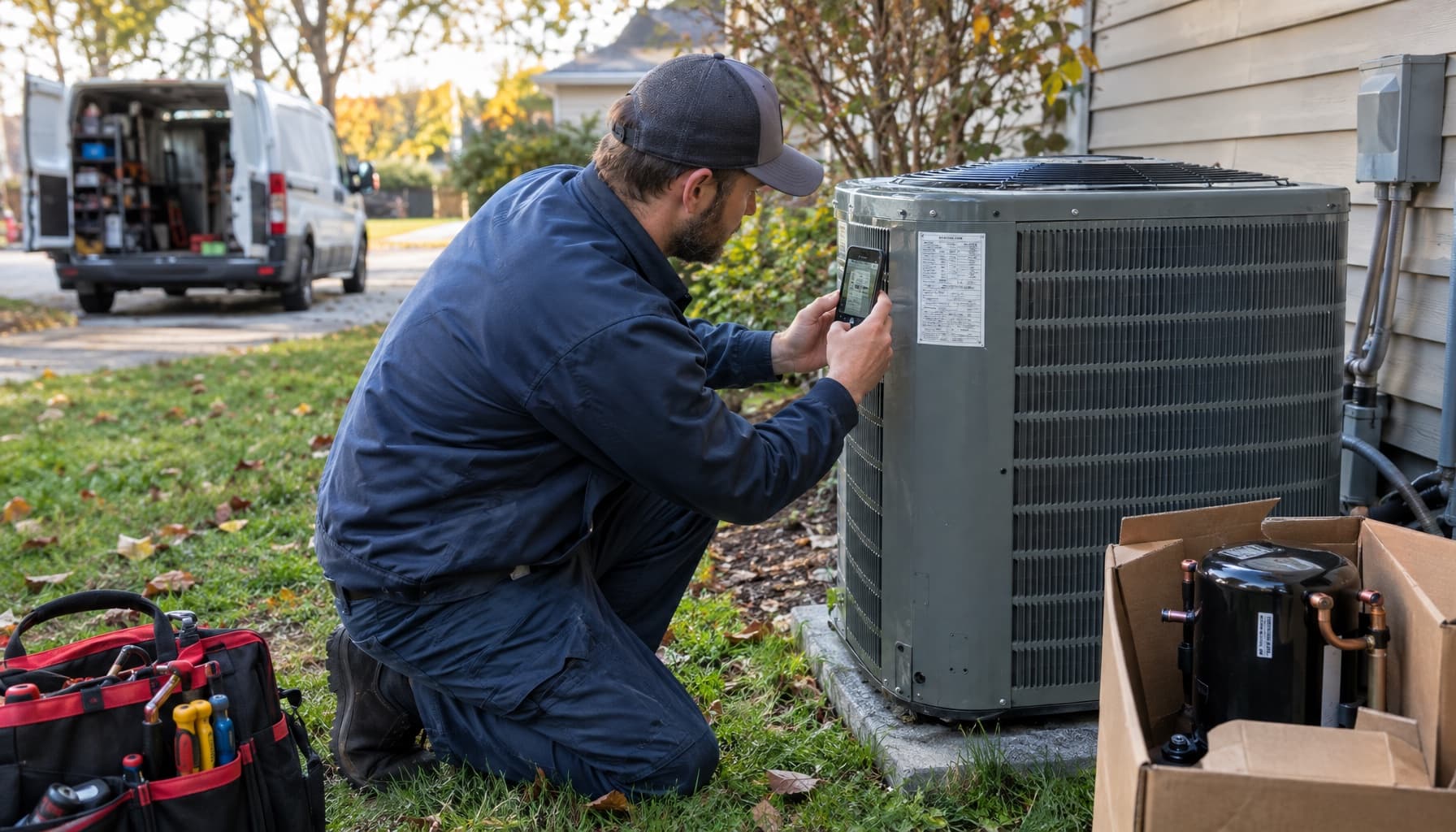
The test: does the serial, the install date, and a photo of the data plate get captured on the job, from the truck, while the tech is still there?
Where FieldCommerce fits
None of these three are ledger problems. They're capture problems. The information exists at the job and dies on the way to the office. FieldCommerce lives at that end. It's field service software for HVAC shops running 1 to 8 trucks, usually with the owner still running calls.
Maintenance plans run as recurring contracts, so the visits you owe show up as scheduled work instead of a note in someone's head. Equipment details and job expenses live on the job record, where the tech logged them. The AI drafts invoice lines from what the tech reports, and the owner reviews before anything goes out. Invoices, clients, and expenses sync to QuickBooks Online through the QuickBooks sync, so your bookkeeper starts from clean records instead of a shoebox.
It won't book your deferred revenue entries or file your warranty claims. Your bookkeeper and your distributor still do that. They'll just have what they need.
See how a call runs from dispatch to paid invoice at FieldCommerce for HVAC, or get started before the fall tune-up rush hits the books.