
Electrical Service Software for 1 to 8 Truck Shops
Electrical service software explained for 1 to 8 truck shops: how service differs from bid work, what the call-to-cash chain needs, and where vendors gate it.
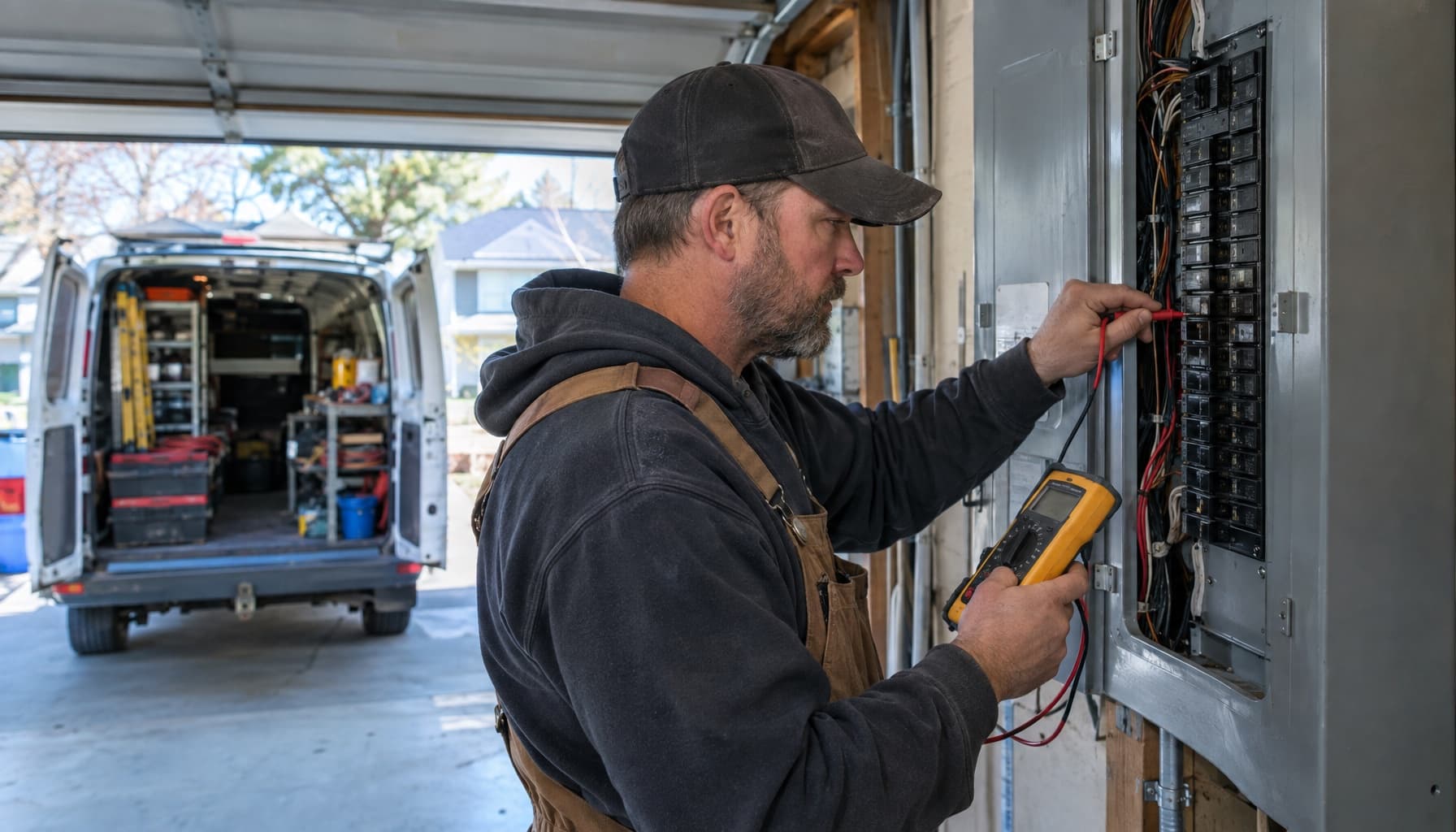
Search "electrical service software" and page one is nine vendor landing pages. Service Fusion, Zuper, FieldEdge, Knowify, ServiceTitan, Housecall Pro, each one selling its own product as the answer before anyone has defined the question. Not one of them stops to notice that the word doing all the work in that search is "service."
Because service is a specific business. It is the no-power call at 7am, the federal-breaker panel that failed inspection, the EV charger install booked off a Google review, the flickering-lights ticket that turns into a loose neutral and a four-hour afternoon. It is not bid work, and software that blurs the two will cost you on whichever side you actually live.
Electrical service software is not electrical contracting software
Type "electrical contracting software" instead and you land in a different aisle: estimating and takeoff platforms like McCormick and TurboBid, built around labor-unit libraries and plan sets, priced and organized for winning bids weeks before a wire is pulled. Those tools are genuinely good at that job. They also, as the estimating vendors themselves admit, do almost nothing for residential and commercial service work, because a service ticket is not estimated at a desk. It is priced in a driveway, often after the diagnosis, sometimes during it.
So sort your revenue before you sort the software. If most of your dollars come off plan sets, you are shopping for estimating software and a job-cost ledger, and the first half of our electrical contractor software guide walks that fork in detail. If most of your dollars come through the phone, one truck roll at a time, keep reading. You need the other thing, and the other thing has different rules.
The clearest rule: in service, speed between steps is the product. A bid can sit a week and lose nothing. A service call that waits a week is a customer who called someone else Tuesday.
What electrical service software has to carry, from first ring to cleared payment
Walk one ticket through your shop and count the handoffs. The call comes in and someone decides how urgent a "half my outlets are dead" actually is. It lands on a schedule, goes out as a dispatch, comes back as a work order full of what the tech found, becomes an invoice, becomes a payment, and lands in QuickBooks. Electrical service software is whatever carries the ticket through that chain without a human re-typing it at every joint. Everything else on the feature list is decoration.
Three links in that chain are trade-specific, and generic apps drop all three.
The dispatch has to know licenses. An apprentice who legally cannot close a job alone is a scheduling fact, not an HR footnote, and a board that treats every tech as interchangeable will eventually send the wrong card to the wrong job. That is an inspection problem and we gave it a full article of its own.
The diagnostic fee has to be plumbing, not memory. Most shops charge a service call fee, commonly somewhere in the $100 to $200 range depending on market, and the standard play is to credit it toward the repair when the customer approves the work. That credit is a closing tool. It is also the first thing that evaporates when the fee lives in the tech's head, the quote lives on a carbon pad, and the invoice gets typed Sunday night from neither. The fee gets waived to end an awkward conversation, or double-charged and disputed, and either way the policy you set stopped being a policy.
Troubleshooting is the only work you sell before you know what it is. The diagnostic fee is how the trade prices that risk, and software that cannot carry the fee through to the invoice is quietly repealing it one awkward driveway conversation at a time.
The invoice has to leave from the driveway. With journeyman billing rates running roughly $85 to $110 an hour in most of the country, an evening of unpaid typing behind every billed day is real money spent converting work you already did into paper. The close-out notes, the found-and-fixed story, the line items: the shop where those leave the site with the tech gets paid this week. The shop where they ride home in the truck gets paid eventually, and eventually has a cost.
The vendors, sorted by who they were built for
Prices below come from the vendors' own pricing pages this month. They move, so verify before signing.
- Jobber advertises Core at $29 a month billed annually, $49 monthly. The QuickBooks Online sync waits on Connect at $99 annual, $139 monthly, plus $29 per additional user, and job costing waits further up at Grow, $149 annual. The ad price books appointments. The working price is two tiers in.
- Housecall Pro starts at $59 a month annual for one user; the QuickBooks sync arrives with Essentials at $149 a month annual with five users. Same shape as Jobber, higher floor.
- Service Fusion is the interesting outlier: unlimited users on every plan, QuickBooks on every plan, and a Starter price of $208 a month billed annually, $245 monthly. Unlimited seats are a great answer to a question a 3 truck shop is not asking.
- FieldEdge and ServiceTitan are built for the service business you might have at 30 trucks, with the dispatcher and office manager that implies. Both sell by demo with unpublished pricing. Deep products, wrong org chart.
Notice what the whole page-one lineup has in common: every product assumes the office still does the typing. The tiers change who pays for the retyping, never whether it happens.
The version where the office work does itself
FieldCommerce was built AI-first for the shop this article keeps describing, where the dispatcher, the estimator, and the senior tech are one or two people. The board knows which techs hold which license. The tech talks through the diagnosis and the fix in plain words, and the AI drafts the close-out notes, the invoice lines, and the service-fee credit from that, on site, the same hour. The QuickBooks sync ships with the product instead of guarding a higher tier. The chain from first ring to cleared payment is one record, which is the entire point of the category once you strip the landing pages off it.
Run the count this week: pull ten closed tickets and mark every place a human re-typed something a human had already entered. That number is what you are actually shopping to fix.
See the whole chain at FieldCommerce for electrical, or get started and put tomorrow's no-power call on a board that knows the trade.