
Plumbing Dispatch Software for the 1 to 8 Truck Shop
Plumbing dispatch software has to survive sewage backups, parts runs, and jobs that triple in length. What a small shop needs and what the big names miss.
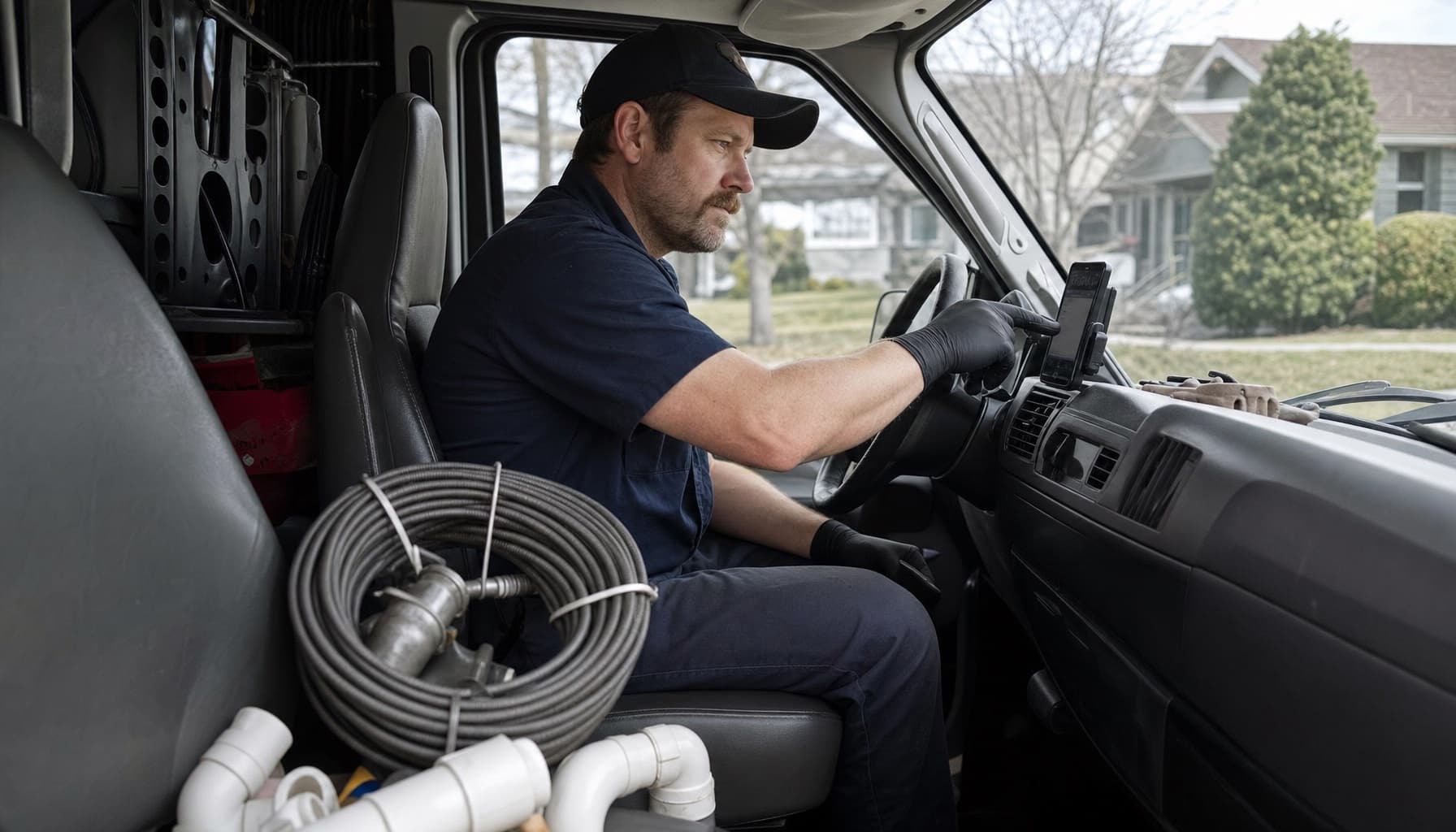
A plumbing board built at 7am is fiction by 9:30. The 45-minute drain call found a bellied line and turned into a camera job. The "simple" water heater swap failed the flue inspection, and now somebody is driving to the supply house. Meanwhile a landlord is on line two with sewage coming up a basement drain, and that call does not wait until Thursday.
HVAC shops get crushed twice a year and can see it coming. Plumbing gets ambushed daily, all year. That difference is exactly what most dispatch software gets wrong, because most of it was designed around appointments, and a plumbing day is not made of appointments. It is made of bets.
What plumbing dispatch software has to survive
Not a demo. A Tuesday. Four things break plumbing boards over and over, and a dispatch tool either handles them or hands them back to you:
- Emergencies that outrank the schedule. A sewage backup or a burst supply line jumps the queue, full stop. The software has to know which booked jobs can slide, which customer will walk if bumped again, and which truck is closest with a jetter on it. A calendar shows the conflict. It does not resolve it.
- Job-length variance that makes HVAC look tame. A snake job runs 45 minutes. A standard tank swap runs three or four hours, and the cost guides put that job at $1,200 to $2,500, so it is not one you rush. A repipe eats days. When the short job goes long, everything downstream moves, and somebody has to call three customers before they call you.
- Parts runs. No plumbing truck stocks everything. The board needs to absorb a 40-minute supply house detour without pretending the 1pm is still a 1pm.
- Two-man jobs. Tankless conversions and attic tanks take a second set of hands. Pairing techs means un-pairing them somewhere else, and doing that math at 9:40am with the phone ringing is the actual job of dispatch.
Every one of those is a re-decision, made mid-morning, under pressure. In a 1 to 8 truck shop there is no dispatcher to make it. There is you, probably under a house. We wrote about that whole predicament in running a dispatch board without a dispatcher, and it is twice as true in this trade.
A plumbing dispatch board is not a plan. It is a bet, re-placed every time a drain call turns into a dig. Software earns its money by re-placing the bet for you.
One more number worth holding onto: the trip fee most plumbing companies charge runs $75 to $150. That is what a truck roll costs the customer. When dispatch sends the wrong truck, the one without the jetter, the one across town, the shop eats that roll instead.
Who ranks for plumbing dispatch software, and why to squint
Search the term and look at who wrote the results. One of the top articles comparing seven dispatch platforms is published by ServiceTitan, and after weighing the field it recommends ServiceTitan. That is not a review. That is a brochure with a rankings font.
ServiceTitan is genuinely powerful, and it is built and priced for the 30-truck operation with a dispatcher, a CSR team, and an office manager. It publishes no pricing; owners in contractor threads report real-world costs running well into four figures a month, and one solo operator asking about a smaller plan called four figures for software flat-out insane. If you run three trucks, you are not the customer that product was shaped for, no matter where its blog ranks.
Plumbing dispatch software: where Jobber and Housecall Pro land
The two names small shops actually try first are more honest, and thinner.
Jobber's entry plan is cheap, $21 a month billed annually as of this writing ($49 month to month), it includes the QuickBooks Online sync on every tier, and it has built-in routing. But the entry plan is one user, extra seats are $29 each, and route optimization waits until the $105 Grow plan. More to the point, nothing in it triages. Eleven open calls with a sewage backup in the middle is your problem to sort, in your head, same as before.
Housecall Pro draws its lines differently: the $59 Basic plan (billed annually) is one user with no QuickBooks sync and no GPS tracking. Both arrive on the $149 Essentials plan with five users. For a plumbing shop past its first truck, that second number is the real price. The drag-and-drop board is pleasant. It is also passive. We put the full head-to-head in FieldCommerce vs Housecall Pro.
Neither product handles the re-decision. They record the schedule you invented and display the wreckage when it slips. The thinking, the part that happens at 9:40am, stays with you. That gap is the whole reason we keep writing about this category, in plumbing business software and for the combined shops in HVAC plumbing software.
Dispatch that re-plans when the day breaks
FieldCommerce starts from the assumption that the plumbing board will break by mid-morning, because it will. Incoming calls get scored on severity, membership, and drive time, so the sewage backup outranks the dripping tub without you adjudicating it from a crawlspace. It weighs tech skills too, so the backup goes to whoever runs the jetter, not whoever happens to be free. When the tank swap goes long or a truck detours to the supply house, it re-plans the rest of the day and flags which customers need the running-late call before it becomes the angry call. And when the job closes, the invoice is drafted from what the tech logged, paid by link in the driveway, which matters in a trade where the trip fee alone is real money.
The test for any of this software is not the feature grid. It is a question: when the 9am drain call becomes a dig, what does the rest of my Tuesday look like, and who fixed it? If the answer is you, with a phone and an apology voice, the software is a calendar.
See it run a plumbing board at FieldCommerce for plumbing, or get started and let the board take its own bets for a while.