
Commercial Electrical Contractor Software at 1 to 8 Trucks
Commercial electrical contractor software for small shops: service work orders, net 30 accounts, pay apps and retainage, and an honest read on BuildOps.
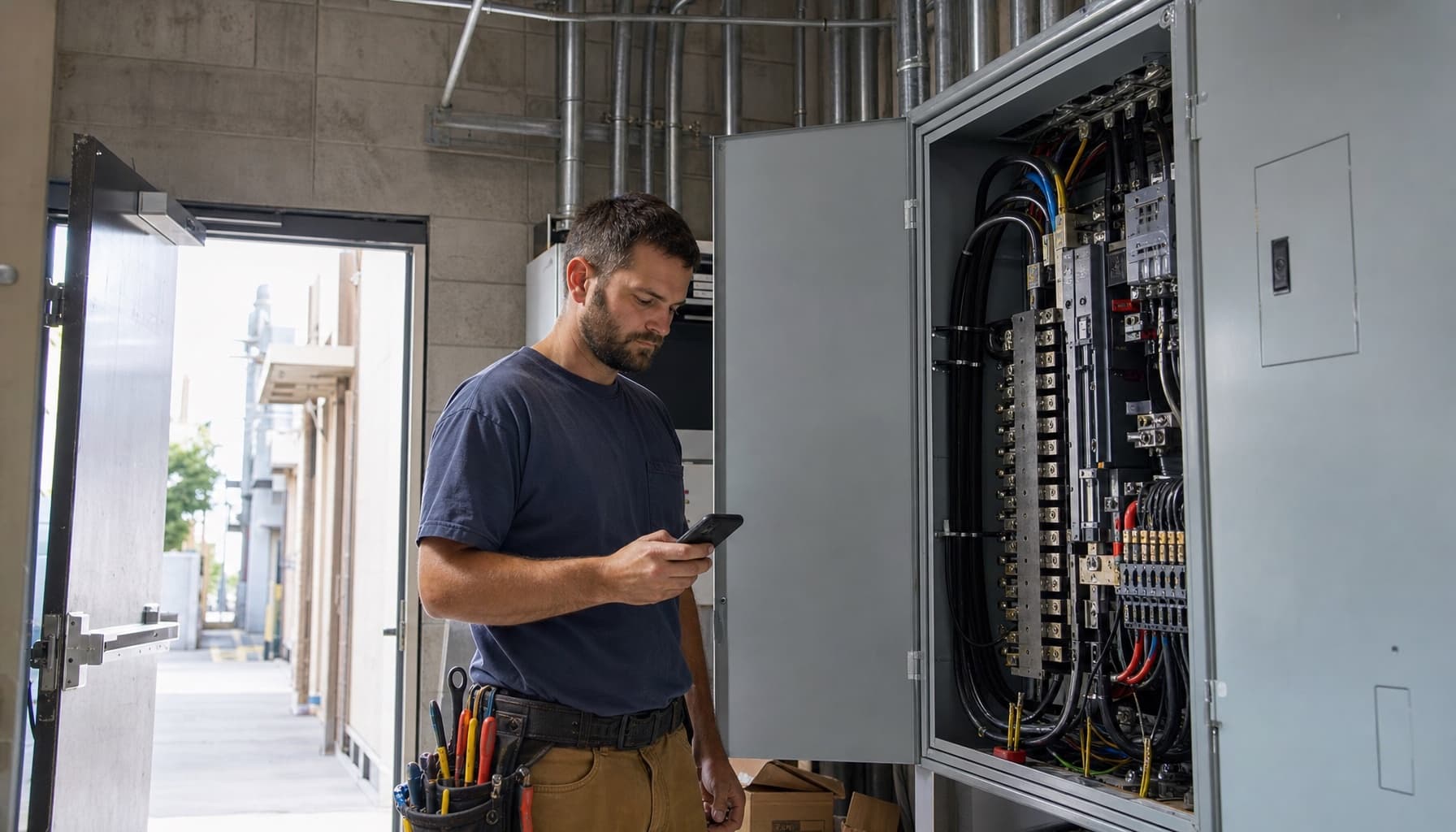
The word "commercial" is carrying two different businesses in that search box. One is project work: a tenant fit-out under a GC, a schedule of values, monthly pay applications, retainage held until closeout. The other is service work: a property manager calls about a dark parking lot, a facilities guy needs a panel labeled before the fire marshal comes back, a restaurant loses half its kitchen circuits on a Friday. Different paperwork, different money, different speed.
Most electrical shops running 1 to 8 trucks on the commercial side do both at once. And almost every software product that shows up when you search the phrase is built for exactly one of the halves, which is why so many small commercial shops end up disappointed twice.
Two kinds of commercial work, two kinds of money
Project money moves slow because the contract says it can. On GC work you bill through progress payments, usually on AIA-style G702 and G703 forms: a schedule of values, a percent complete on each line, and 5 to 10 percent retainage held back until the job closes out. Then you wait. Billd's 2025 subcontractor payments survey put the average wait at 56 days after the pay app goes in, while GCs in the same survey believed they were paying in about 30. On the Mike Holt forums, contractors report larger GCs drifting toward net 90 as a matter of policy, financing the project on the backs of their subs, with pay-when-paid clauses to point at when the money stalls. The old hands there give the same advice they have given for years: do not set trim until the rough draw is paid, because after the job is done you have nothing left to hold back.
Service money is a different animal. A property manager with six strip centers sends you work orders all year: ballast swaps, EV charger faults, panel work, tenant improvements small enough to skip the GC. The tickets are small, a few hundred to a few thousand dollars each, they run on net 30, and a good account keeps a truck busy for years if you hold onto it. But the forum advice on property managers is blunt for a reason: some are great, and some will burn through every contractor in town before circling back. The first emergency call from a new PM should be COD. After that, the account is won or lost on paperwork. A PM who gets a clean, itemized invoice with the work order number on it the day after the call has no reason to shop around. A PM chasing you for backup three weeks later already is.
You cannot invoice your way out of a pay-when-paid clause. You can absolutely invoice your way out of a slow service ticket. Buy software for the problem you can fix.
What commercial electrical contractor software actually has to handle
Search the phrase and look at who ranks. BuildOps has the strongest claim to the term, and it is genuinely built for commercial electrical contractors, which is exactly the problem: it is built for the big ones. Pricing is quote-only and per-user, third-party figures run anywhere from $50 to over $200 per user monthly depending on scope, and implementation is a project with a fee attached. It assumes an office staff feeding it. ServiceTitan tells the same story at enterprise scale. Housecall Pro ranks with a commercial page wrapped around what is at heart a residential calendar app; it has no idea what a pay application is. On the billing end sit tools like Werx and Knowify, construction billing done properly, with Werx publishing plans from $49 a month and $6 per added user for G702 and G703 style pay apps with retainage tracking.
Notice what is missing: nothing on page one is built for the shop with three vans, one owner who still bends pipe, and a mixed book of PM accounts and the occasional fit-out.
So here is the position an experienced operator would take. At 1 to 8 trucks, no single product runs both halves well, and you should stop shopping for one that does. The project half is a low-volume paperwork problem: a few pay apps a month that your bookkeeper or a $49 billing tool can produce. The service half is a high-volume operations problem: dozens of work orders a month across properties, each needing dispatch, capture, and a same-day invoice. Volume problems are software problems. Buy for the service side, and test against this list:
- Customer records that understand properties. One PM account, twelve locations, a service history and panel schedule per building. When the call is "unit 4B again," the tech should know what is in that closet before the truck rolls.
- T&M capture at the truck. Hours by tech by day, material off the shelf as it happens. We wrote up the whole discipline in our T&M billing guide, and commercial service is where it pays most, because commercial invoices get audited.
- Invoices a PM can forward without a phone call. Work order number, location, itemized labor and material. That is what backup means, and it is the difference between net 30 and net 60 in practice. The collection math is in our days sales outstanding guide.
- A view of unbilled tickets. On accounts work, the ticket that never became an invoice is pure loss, and at work-order volume you will not catch it from memory.
- Dispatch without a dispatcher. Routing a fault call around scheduled PM work is a daily puzzle at this size, and we covered it in our electrician dispatch guide.
Choosing commercial electrical contractor software at 1 to 8 trucks
FieldCommerce was built AI-first for the service half of exactly this shop. Properties and their histories live on the account, so the panel schedule and the last three visits to that suite are in the tech's hand before he parks. The tech tells the app what happened, in plain words, and the invoice drafts itself the same day with the work order number and the itemized backup a property manager expects. Unbilled work is visible instead of remembered.
It will not print you a G702. If most of your revenue is GC project work, run the pay apps through a construction billing tool and let that be that. But if your book looks like most small commercial shops, a pile of PM accounts, steady T&M tickets, and a fit-out now and then, then the service loop is where the money leaks, and it is the half software can actually fix. See how it fits at FieldCommerce for electrical, or get started before the next work order gets invoiced three weeks late.