
How to Get More Google Reviews for Your Trades Business
The system small trades shops use to get more Google reviews: who asks, exactly what to say, the same-evening text, and how to answer the bad one.
The private-equity rollups moving into your market have a playbook: buy three shops, slap a call center on top, and outspend everyone on ads. What they cannot buy is four hundred neighbors saying your tech showed up on time, fixed it right, and cleaned up after himself. Reviews are the one channel where a four-truck shop beats a hundred-truck operation, because reviews are earned one job at a time, and you are the one actually in the crawlspace.
Most owners know this and still have 43 reviews from six years of good work. The problem is never the work. It is that nobody asks. Here is the system that fixes it.
Why review velocity beats total count
Google does not just count your reviews. It watches how recently and how steadily they arrive. A shop with 120 reviews and three new ones this month looks alive. A shop with 300 reviews and nothing since last summer looks like it changed hands or went downhill. Homeowners read it the same way: they sort by newest and skim the last month, not the lifetime total.
That is good news for a small shop. You cannot catch a rollup with 2,000 legacy reviews on raw count, and you do not have to. You have to out-earn them this month. A steady drip of fresh, local reviews will float you above a bigger competitor whose count is a monument to work done years ago. Velocity is the game, and velocity comes from a system.
Reviews also compound with the rest of your local presence. If your listing itself is a mess, fix that first. Our companion piece on setting up your Google Business Profile covers the foundation this post builds on.
The system to get more Google reviews
Every step here exists because of one fact: the willingness to leave a review peaks in the first few hours after the fix and falls off a cliff by the next morning. Everything below is about catching that window.
Ask at the door, while the fix is still warm
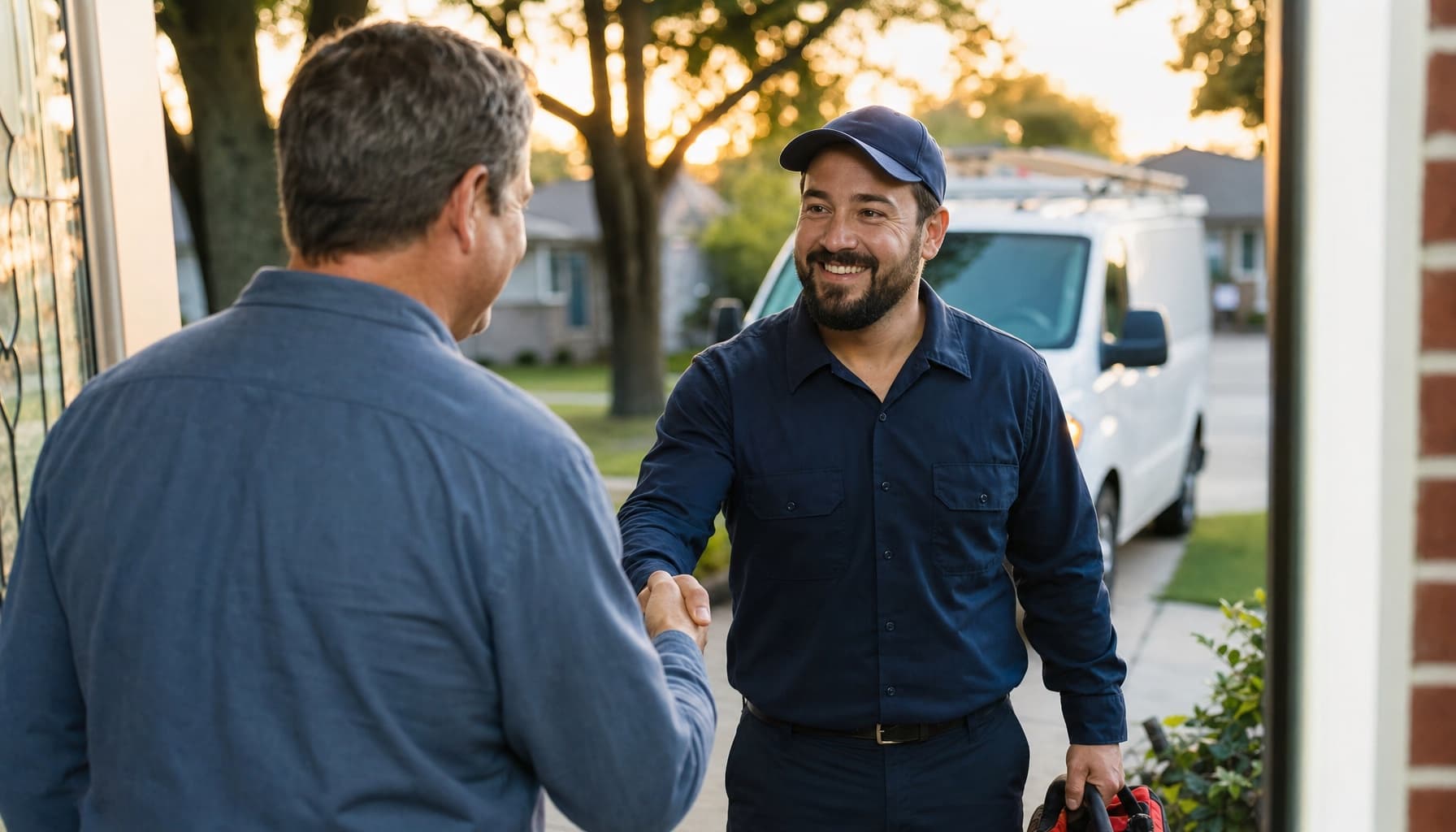
The highest-converting moment is the doorstep, right after the customer sees the AC blowing cold or the water heater working. They are relieved, they are grateful, and the person who earned that gratitude is standing right there. An email three days later cannot compete.
The tech asks, not the office
The person who did the work makes the ask. Not a follow-up call from the office, not a survey from a no-reply address. The customer wants to thank the human who crawled under the house, and a review is the easiest way you can offer them to do it. Make the ask part of the job close-out, the same as collecting payment, so no tech has to decide whether today is an asking day.
Say it plainly
Techs skip the ask because it feels like begging. Give them words that do not:
"Glad we got you sorted. Reviews on Google are honestly how a shop our size stays in business against the big guys. If you have thirty seconds tonight, it would mean a lot. I'll text you the link so you don't have to hunt for us."
No pressure, no script voice, and it names the truth: the review helps a local shop compete. Homeowners like being on that side.
Text the link the same evening
The doorstep ask plants the seed. The text closes it. That evening, the customer gets one message: a thanks, the tech's name, and a direct link to your Google review form. Not your homepage, not a "leave us feedback" page with four options. One tap to the review box. Send it while the visit is still today's story at the dinner table.
Automate the trigger
Review programs die because a human has to remember them. Tie the request to something that already happens on every job. The cleanest trigger is the paid invoice: money collected, job closed, request goes out. No happy customer slips through because Tuesday was chaos.
What never to do
- Never buy reviews. Google's filters catch purchased batches, and the penalty is suppressed reviews or a suspended profile. For a shop that lives on local search, that is a self-inflicted outage.
- Never fake them. Reviews from your cousin, your techs, or your own devices are trivially detectable and legally risky. The FTC now fines businesses for fake reviews, and competitors report them.
- Never gate. Sending happy customers to Google and steering unhappy ones to a private form violates Google's policy. Ask everyone the same way.
- Never bribe. A discount for a review breaks the rules and taints the reviews you already earned honestly.
The shortcut costs more than the slow road. Every fake review a rollup call center generates is a liability. Every real one you earn is a moat.
Answering the bad review so it wins the next customer
You will get a bad one. Everyone does, and prospects read the bad reviews first. They are not looking for perfection. They are looking at how you behave when something goes wrong.
Reply within a day. Thank them, own what was yours, say plainly what you did about it, and offer to make it right offline with a real phone number. No excuses, no arguing in public, no matching their tone. Two calm sentences from an owner who clearly cares win more jobs than five glowing reviews, because the reader is imagining being the person with the problem.
How many Google reviews a four-truck shop can expect
Here is the honest math for a four-truck shop. Say you close 120 to 160 jobs a month. With a doorstep ask plus a same-evening text on every job, a 10 to 20 percent conversion is realistic. That is 12 to 30 new reviews a month, and even the low end puts you among the fastest-moving profiles in most local trades markets within a quarter.
Keep it alive with ten minutes a week: check that requests went out on every closed job, reply to every new review with a sentence that mentions the job and the town, and read the misses for patterns. If one tech converts at triple the rate of another, that is a coaching conversation, not a mystery.
This is exactly the loop we built into FieldCommerce. When the invoice is paid, the review request fires automatically with the tech's name and your direct review link, and it lives in the same system as your scheduling, dispatch, and invoicing, so there is no separate reputation tool to babysit. The same connected flow matters upstream too: a review only exists because you answered the call in the first place, which is its own leak worth plugging.
The rollups can buy trucks, wraps, and ad budgets. They cannot buy this month's thirty genuine reviews in your zip code. Start the doorstep ask this week, automate the follow-up, and let the moat dig itself. When you want the request wired straight to your paid invoices, get in touch, and if you run an HVAC shop, see how it fits your seasonal rush at FieldCommerce for HVAC.